The Best Android Car Stereos in 2026 (Android Auto & True-Android Picks)
“Android car stereo” means two very different things: a head unit that runs Android Auto from your phone, and a head unit that runs the Android operating system itself. Most searchers want the first. We picked the best of both camps — every spec cited to Crutchfield or the manufacturer, and every inflated “watts” claim decoded.
First, the reframe that saves you money. When most people search for an “Android car stereo,” they want their Android phone’s maps, music and voice control on the dash — and the right tool for that is an Android Auto receiver from Sony, Pioneer, Alpine, Kenwood or Boss. Google’s Android Auto software runs on your phone and mirrors a driver-safe interface onto the head unit; the stereo itself stays simple, fast and stable. The other camp — “true Android” units from ATOTO, Pumpkin or Eonon — runs a full Android OS on the head unit itself, like a tablet bolted into your dash. More apps, more tinkering, more caveats. We cover both, honestly.
Our two anchors: the Sony XAV-AX6000 is the best Android Auto head unit for most people — a 6.95″ bezel-less capacitive screen, wireless Android Auto, a 5-volt preamp section and iDatalink Maestro support. The BOSS Audio Elite BE7ACP.WX is the budget shock of 2026 — wireless Android Auto and hi-res FLAC playback for entry money, and Crutchfield’s own pick for “best wireless Android Auto and Apple CarPlay on a budget.” Around them: Pioneer’s integration king, Alpine’s sound-quality pick, Sony’s 10.1″ floating screen, and the one true-Android unit we’d actually consider — with its real trade-offs printed next to it.
The picks at a glance
Six head units across both camps — every power figure below is the honest RMS (CTA-2006) rating, cited, not the marketing “peak.” Compare here, then jump to any full write-up.
| Head unit | Best for | Standout (cited) | Get it |
|---|---|---|---|
 Sony XAV-AX6000 AA receiver · 6.95″ | Best overallWireless AA, most people | Wireless Android Auto + 5V preamp outs + Maestro · 20 W RMS ×4 (CTA-2006) | |
 Pioneer DMH-W4660NEX AA receiver · 6.8″ | Best integrationMaestro, 2 cam inputs | iDatalink Maestro + dual camera inputs · HD Radio · 14 W RMS ×4 (CTA-2006) | |
 Alpine iLX-507 AA receiver · 7″ hi-res | Best soundHi-res audio, slim chassis | 1280×720 screen + hi-res FLAC (96/24) · 4V preamp · 16 W RMS ×4 | |
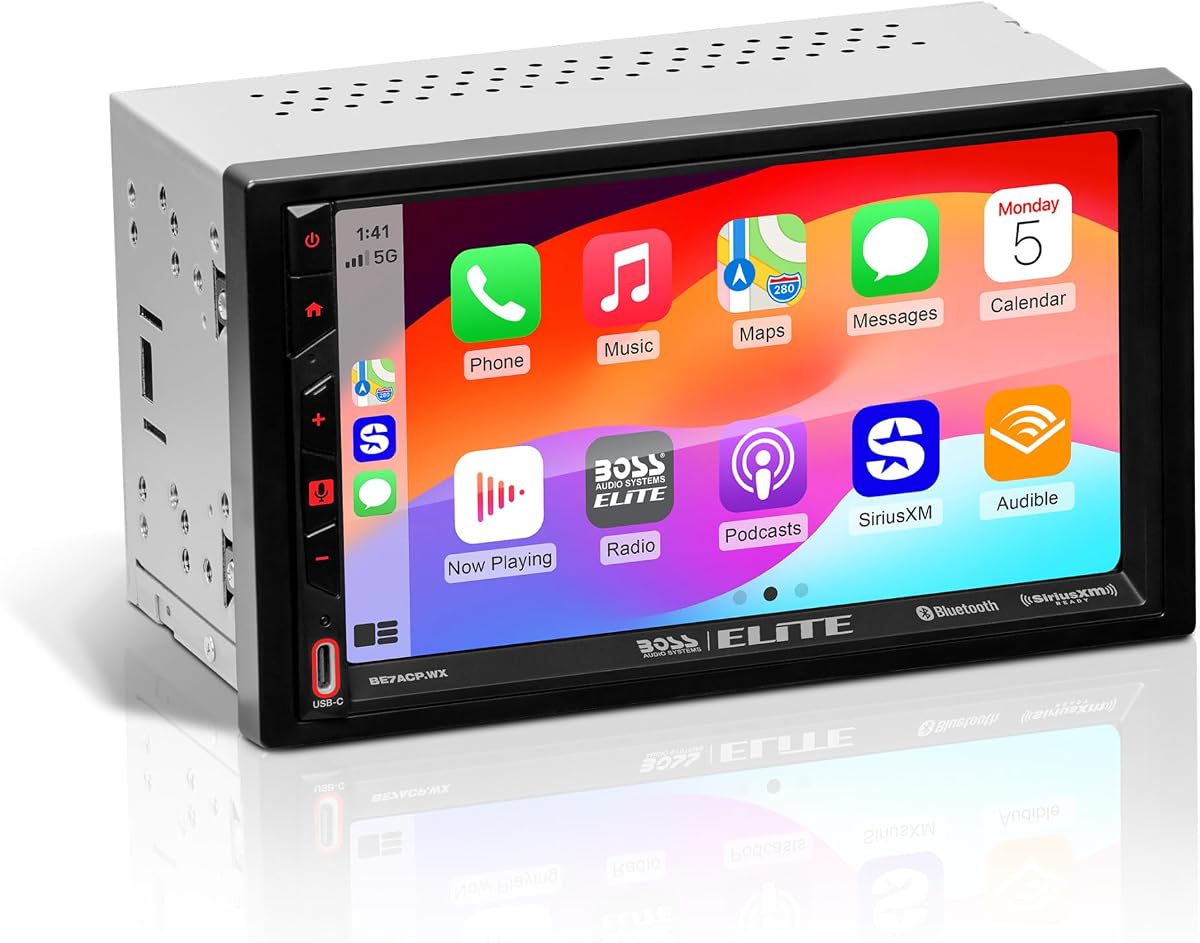 BOSS Elite BE7ACP.WX AA receiver · 7″ budget | Best budgetWireless AA for less | Wireless AA + hi-res FLAC (192/24) · Crutchfield budget pick · 20 W RMS ×4 | |
 Sony XAV-AX8500 AA receiver · 10.1″ float | Best big screenSingle-DIN chassis, huge display | 10.1″ floating capacitive screen · wireless AA · 3 camera inputs · 20 W RMS ×4 | |
 ATOTO S8 Ultra (Gen 2) True Android-OS · 7″ QLED | True-Android pickApps on the unit itself | Full Android OS + 4G modem + DSP · wireless AA built in · 29 W RMS ×4 (mfr) |
Which head unit is right for you?
Skip the spec overwhelm — match your situation to the pick.

The honest spec sheet, side by side
Every power figure is the RMS (CTA-2006) rating — the number that survives real listening — not the “peak” on the box. Sources footnoted below.
| Model | Android Auto | Screen | DIN | Cam input | Preamp outs | RMS power (CTA-2006) |
|---|---|---|---|---|---|---|
| Sony XAV-AX6000 | Wired + wireless¹ | 6.95″ capacitive, bezel-less | Double | Rear (guidelines) | 5V, 3 pairs (F/R/sub)¹ | 20 W ×4 (55 W peak)¹ |
| Pioneer DMH-W4660NEX | Wired + wireless² | 6.8″ capacitive | Double | 2 inputs (backup + aux)² | 4V, 3 pairs (F/R/sub)² | 14 W ×4 (22 W mfr / 50 W peak)² |
| Alpine iLX-507 | Wired + wireless³ | 7″ capacitive, 1280×720 | Double (slim chassis)³ | 2 inputs (backup + aux)³ | 4V, 3 pairs (F/R/sub)³ | 16 W ×4 (50 W peak)³ |
| BOSS Elite BE7ACP.WX | Wired + wireless⁴ | 7″ capacitive | Double | Front + rear inputs⁴ | 4V, 3 pairs (F/R/sub)⁴ | 20 W ×4 (85 W peak)⁴ |
| Sony XAV-AX8500 | Wired + wireless⁵ | 10.1″ floating capacitive | Single (chassis)⁵ | 3 camera inputs⁵ | 5V, 3 pairs (F/R/sub)⁵ | 20 W ×4 (CTA-2006)⁵ |
| ATOTO S8 Ultra (true Android-OS) | Wired + wireless (built-in link)⁶ | 7″ QLED touchscreen⁶ | Double | Rear (LRV support)⁶ | Pre-outs + sub (0.8V)⁶ | 29 W ×4 RMS (49 W max — mfr)⁶ |
- “Peak” watts are marketing, RMS is reality: every receiver here advertises a peak figure 2–4× its honest CTA-2006 RMS rating (Boss: 85 vs 20 W; Sony: 55 vs 20 W; Pioneer: 50 vs 14 W). CTA-2006 measures continuous full-bandwidth power into 4Ω at 1% THD — that’s the comparable number.⁸
- Pioneer publishes two honest numbers: 14 W RMS ×4 under the stricter CTA-2006 method, and 22 W ×4 as its own “continuous” rating — we print the stricter one and show both.²
- Maestro on the Boss needs a software update: Crutchfield lists iDatalink Maestro compatibility on the BE7ACP.WX “with upcoming software update” — if Maestro is mission-critical on day one, the Pioneer or Sony is the safer buy.⁴
- The ATOTO’s sub pre-out is weak: ATOTO lists a 0.8V subwoofer output — far below the 4–5V on the name-brand receivers. Planning a real amp-and-sub build? That’s a genuine limitation, not a nitpick.⁶
- Wireless Android Auto needs a modern phone: Google requires an Android 11+ phone for wireless Android Auto (check g.co/androidauto/requirements). Wired AA works on far older phones.
Sources: ¹ Crutchfield — Sony XAV-AX6000 (20 W RMS CTA-2006/55 peak; 5V 5-ch preamp; Maestro; HDMI) · ² Crutchfield — Pioneer DMH-W4660NEX (14 W RMS CTA-2006, 22 W continuous mfr, 50 peak; 4V 6-ch preamp; 2 cam inputs; HD Radio) · ³ Crutchfield — Alpine iLX-507 (16 W RMS CTA-2006/50 peak; 1280×720; hi-res FLAC 96/24; slim chassis) · ⁴ Crutchfield — BOSS Audio Elite BE7ACP.WX (20 W RMS/85 peak; wireless AA; hi-res FLAC 192/24; Maestro via update) · ⁵ Crutchfield — Sony XAV-AX8500 (10.1″ floating capacitive; single-DIN chassis; 3 cam inputs; 5V 6-ch preamp) · ⁶ ATOTO — S8 Ultra official page (RMS 4×29 W / max 4×49 W; 0.8V sub out; AICE UI on Android) · Sony press release / Google — wireless AA requires Android 11+ · ⁸ Crutchfield — CTA-2006 spec definitions. Prices move — check current price before buying.
The six picks, in depth
Sony XAV-AX6000 — the Android Auto head unit most people should buy
The AX6000 is the no-drama pick. Its 6.95″ bezel-less capacitive touchscreen is anti-glare and responds like a phone, and it runs wired and wireless Android Auto plus wireless Apple CarPlay — Sony even bundles the GPS antenna wireless AA needs for best results (Crutchfield). Power is an honest 20 W RMS ×4 (CTA-2006) — ignore the “55 W” peak on the box — with a clean 5-volt, three-pair preamp section (front/rear/mono-sub) for when you add amplifiers later.
It’s also unusually install-friendly: the chassis is compact, there’s an HDMI input for video sources, a rear-camera input with parking guidelines, and full iDatalink Maestro support so a compatible interface can keep your factory steering-wheel controls, factory amp and vehicle settings in a wide range of cars. USB-C up front finishes a genuinely complete package.
Pioneer DMH-W4660NEX — the one for newer, option-loaded cars
If your car has factory steering-wheel controls, a factory backup camera, a factory amp or vehicle-data displays you don’t want to lose, this is your receiver. The W4660NEX pairs wired + wireless Android Auto and wireless CarPlay on a 6.8″ capacitive screen with deep iDatalink Maestro support, an HD Radio tuner, SiriusXM-readiness, and two camera inputs — a dedicated backup input with guidelines and auto-switching, plus a second composite input for a front or trailer camera (Crutchfield).
The honest caveat is power. Pioneer’s built-in amp is rated 14 W RMS ×4 (CTA-2006) — or 22 W ×4 by Pioneer’s own continuous method — against a “50 W peak” marketing figure. That’s the weakest honest rating here, though the 4-volt, six-channel preamp outputs mean it’s clearly designed to feed outboard amps. Feeding stock speakers in a quiet car? Fine. Planning to crank it on the highway without an amp? Look at the Sony or Boss.
Alpine iLX-507 — the audiophile’s Android Auto receiver
The iLX-507 is what you buy when the head unit is the start of a real system. It plays hi-res FLAC up to 96 kHz/24-bit through a 24-bit DAC, tunes with a 13-band parametric EQ, 6-channel time correction and crossovers, and feeds amps through 4-volt, six-channel preamp outputs. The 7″ capacitive screen is a cut above too — 1280×720 resolution where most rivals run 800×480 — with wired and wireless Android Auto and CarPlay, HD Radio and an HDMI output (Crutchfield).
Two practical wins: the slim chassis leaves extra room for harnesses in cramped double-DIN openings (genuinely useful in older trucks and imports), and iDatalink Maestro support keeps factory features alive. Power is 16 W RMS ×4 (CTA-2006) — respectable, but this unit is at its best driving outboard amplification. It’s the priciest mainstream pick here; you’re paying for the DAC, the screen and the tuning, not watts.
BOSS Audio Elite BE7ACP.WX — the budget pick that isn’t a compromise
Crutchfield named this its “best wireless Android Auto and Apple CarPlay on a budget” for 2026, and the spec sheet shows why (Crutchfield): a 7″ capacitive screen, wired and wireless Android Auto and CarPlay, hi-res FLAC playback up to 192 kHz/24-bit, 13-band EQ with crossovers and time alignment, front and rear camera inputs, and 4-volt six-channel preamp outputs — a feature list that read like flagship territory two years ago (Crutchfield).
Honest caveats, because it’s still a budget unit. The amp is 20 W RMS ×4 against an “85 W peak” sticker — fine, but don’t believe the sticker. iDatalink Maestro support is listed as arriving “with upcoming software update,” so if factory-feature retention is critical today, buy the Pioneer. And Boss’s fit, finish and support aren’t Sony or Alpine grade. At this price, none of those are dealbreakers.
Sony XAV-AX8500 — a 10.1″ screen for a single-DIN slot
The AX8500 solves the oldest problem in car audio: your dash only fits a single-DIN radio, but you want a real screen. Its 10.1″ floating capacitive display mounts on a single-DIN chassis with four-way adjustment, runs wired and wireless Android Auto and CarPlay, and offers three camera inputs (front, rear and a third), a micro-HDMI input and a 5-volt six-channel preamp section with iDatalink Maestro support (Crutchfield). It’s Crutchfield’s “best high-end stereo with a floating screen” for 2026 (Crutchfield).
Power is an honest 20 W RMS ×4 (CTA-2006), same as the AX6000. Two cautions: a screen this size can block vents or controls in some dashes — check your clearance before falling in love (a vehicle-fit lookup, like Crutchfield’s, will flag it) — and don’t confuse it with the older XAV-AX8100, which is wired-only with a resistive screen. This is the one you want.
ATOTO S8 Ultra (Gen 2) — the actual Android computer for your dash
This is the other kind of “Android car stereo”: the S8 Ultra runs a full Android-based OS (ATOTO’s AICE UI 11, built on Android 10) on an octa-core chip with 4 GB RAM / 64 GB storage, a 7″ QLED screen, a built-in 4G cellular modem (add a SIM), dual Bluetooth with aptX HD, and a proper DSP (ATOTO). It runs apps on the unit — offline navigation, Torque, dashcam viewers — and still does wired and wireless Android Auto and CarPlay through its built-in phone-integration link. ATOTO rates the amp at an unusually honest 29 W RMS ×4 (49 W max).
Now the honest trade-offs, because this camp earns them. The Android build is a heavily skinned, older base — not the clean, Google-certified experience your phone gets. Support, updates and warranty are brand-direct, not dealer-network deep. Build quality varies more than the big brands. And the subwoofer pre-out is just 0.8 volts — weak for a serious amp-and-sub build. Buy it because you want the computer, not because it’s a better receiver.
Watts decoded: why the box says “85 watts” and the spec sheet says 20
Every head unit here advertises a peak power figure that’s two to four times its honest continuous rating. The number that survives real listening is the RMS rating under CTA-2006 — the industry standard test that measures continuous full-bandwidth output (20 Hz–20 kHz) into 4Ω at 1% THD, which is what lets you compare one brand against another (Crutchfield). So the Boss’s “85 W peak” is really 20 W RMS ×4; Sony’s “55 W peak” is really 20 W RMS ×4; Pioneer’s “50 W peak” is really 14 W RMS ×4. Same trick as home receivers, louder sticker.
Two honest notes before you fixate on watts. First, the differences here are small in practice — 14 vs 20 W RMS is audible only at the top of the dial, and for most commutes any of these is plenty. Second, if loud-and-clean is the goal, the preamp outputs matter more than the built-in amp: feed a proper amplifier from the 4–5-volt pre-outs on the Sony, Alpine, Pioneer or Boss and the RMS figure stops being the bottleneck (see our guides to the best 4-channel amps and best 12-inch subwoofers).
Android Auto receiver vs true Android-OS unit: the fork that decides everything
This is the decision the search results blur. An Android Auto receiver (Sony, Pioneer, Alpine, Kenwood, Boss) is a purpose-built car stereo: Google’s Android Auto software runs on your phone and projects a driver-safe interface — Maps, Spotify, voice — onto the screen. The hardware stays simple, boots fast, and gets its app updates through your phone. A true Android-OS unit (ATOTO, Pumpkin, Eonon) is an Android computer in the dash: it runs apps on the unit itself, takes a SIM card, plays anything the Play-store-style ecosystem offers — and inherits Android’s update, stability and security quirks on hardware that varies wildly in quality.
Our honest read: most searchers want the first kind. If your goal is “my phone’s apps on the dash, reliably,” a name-brand Android Auto receiver is the lower-risk buy — certified phone integration, dealer-grade support, proper camera inputs, honest CTA-2006 power ratings. Buy the true-Android camp only if you specifically want apps living on the head unit — offline nav without a phone, OBD apps like Torque, a 4G SIM — and you accept a skinned, older Android base (the ATOTO S8 Ultra’s AICE UI 11 is built on Android 10), brand-direct support and weaker preamp hardware (ATOTO).
What actually matters when you choose (and what doesn’t)
Capacitive screen, not resistive. Every pick here uses a phone-style capacitive touchscreen — the difference in daily use is enormous versus the pressure-based resistive panels on older and bargain units. Resolution is the tie-breaker: the Alpine iLX-507’s 1280×720 panel is visibly sharper than the 800×480-class screens elsewhere in the category (Crutchfield).
Wireless Android Auto — if your phone supports it. All six picks do wired and wireless AA. Wireless needs a phone with Android 11 or higher (and 5 GHz Wi-Fi); older phones fall back to the cable, which also charges — not the worst trade (Sony). Note that Sony bundles a GPS antenna with the AX6000 and AX8500 because wireless AA/CarPlay works best with it installed.
Camera inputs and factory-feature retention. Count your cameras: one rear input (Sony AX6000), two (Pioneer, Alpine, Boss), or three (Sony AX8500). And if your car has steering-wheel controls, a factory camera, a factory amp or vehicle-data screens, you want iDatalink Maestro compatibility — deepest on the Pioneer, present on both Sonys and the Alpine, and promised via an upcoming software update on the Boss (Crutchfield).
Preamp voltage if you’ll ever add amps. 5 V (Sony) or 4 V (Pioneer, Alpine, Boss) three-pair pre-outs are the clean foundation for an amplified system. The ATOTO’s 0.8 V sub output is the honest weak link in the true-Android camp.
Installation reality: fit checks, harnesses and when to pay a pro
A head unit is not a universal-fit part. Three things stand between the box and a working install: a dash kit (the trim that adapts the opening), a wiring harness (so you don’t cut factory wires), and often a steering-wheel-control / data interface like iDatalink Maestro to keep factory features. This is where a vehicle-fit lookup earns its keep — Crutchfield’s fit system tells you exactly which kit, harness and interfaces your specific car needs, and flags clearance problems like a 10.1″ floating screen blocking vents (Crutchfield).
DIY is realistic on older cars with a simple double-DIN opening and no factory amp — crimp a harness, mount the kit, route the mic and GPS antenna. Pay a professional when the car has a factory amplifier, MOST fiber-optic audio (many European cars), integrated climate or vehicle-settings screens, or when you’re adding cameras. A clean camera run alone — through the hatch, into the tailgate grommet — is the hour most DIYers underestimate. And one last honest warning from the legacy days of cheap Android units: never disable the parking-brake video lockout; video on the driver’s screen while moving is exactly what that wire exists to prevent.
Finish the system around your new head unit
A head unit is the brain of the dash — but the upgrades you feel every day are the ones it feeds. A few companion reads from our car-audio bench:
- 🚗 Only a single-DIN slot? More options beyond the floating-screen Sony → the best single-DIN head units
- 🔊 Speakers next? The stock door speakers are usually the weakest link → the best car speaker brands and the best 6×8 speakers
- ⚡ Adding real power? Those 4–5V pre-outs are made for this → the best 4-channel amps
- 💥 Bass? The sub output on every pick here is waiting → the best 12-inch subwoofers
- 🔌 Keeping the factory radio instead? You can add bass without a new head unit → how to install a powered subwoofer to a factory stereo
And whichever route you go: buy the dash kit, harness and Maestro interface for your exact vehicle at the same time as the head unit — it’s the difference between a Saturday-morning install and a two-week parts chase.
Catch these head units on sale
Car stereo prices swing hard around model-year changeovers and holiday sales — last year’s flagship is often this year’s clearance. Join our Deal Alerts and we’ll email you the genuinely good car-audio deals and honest buying tips — no spam, unsubscribe anytime.
Double opt-in, so confirm via the email we send. No spam — just real deals and useful AV advice.
Frequently asked questions
- Is an “Android car stereo” the same thing as Android Auto?
- Do I need a double-DIN opening for these?
- Will I lose my steering-wheel controls and factory backup camera?
- Do these head units work with iPhones too?
- Is wireless Android Auto worth paying for — and will my phone support it?
- Can I install a head unit myself?