Are Any TVs Made in the USA? (2026)
Short answer: no TV sold today is 100% “Made in the USA” — the display panel alone makes that nearly impossible. A handful are assembled in the US from imported parts, and most mainstream brands now build in Mexico. Here’s the honest, FTC-grounded picture, with every claim cited.
“Where is my TV made?” sounds like a simple question, but the honest answer has three layers — and most “American-made TV” lists online blur them together. The plain truth: essentially no TV on the consumer market is 100% “Made in the USA,” and almost none can legally use that label without qualification, because a TV’s most expensive and important part — the LCD or OLED panel — is overwhelmingly made overseas. A few TVs are genuinely assembled in the US (a weaker, different claim), and the big brands you actually shop for build the vast majority of their sets in Mexico, China, and Vietnam. This is an explainer, not a review — every factual claim is tied to a named source, and where a company’s status is uncertain or dated, we flag it instead of overstating it.
The honest answer (TL;DR)
No 100%-American TVs. A few US-assembled ones. And a reality most lists won’t tell you.
“Made” vs “Assembled” vs “Designed” in the USA — what the labels really mean
These three phrases get used loosely in marketing, but the FTC treats them very differently — and the gap matters for TVs specifically. Get these straight and most “American-made TV” claims fall apart on contact.
“Made in USA” — the strict one. To label a product “Made in USA” without qualification, the FTC requires it be “all or virtually all” made in the United States: the final assembly or processing occurs in the US, all significant processing occurs in the US, and all or virtually all components are made and sourced in the US (FTC)1. The FTC’s 2021 Made in USA Labeling Rule codified this and made violations punishable by civil penalties of up to roughly $51,744 per violation (Federal Register; Morgan Lewis)3,4. It applies to express or implied claims, so a flag graphic or “American” branding doesn’t dodge it either (FTC blog)10. Why no TV clears this bar: the imported panel — plus most chips and boards — means a TV is nowhere near “all or virtually all” US content (AllAmerican.org)2.
“Assembled in USA” — the qualified one. The FTC allows an unqualified “Assembled in USA” claim only when a product’s principal assembly takes place in the US, that assembly is substantial, and the product was last substantially transformed in the US (FTC)1. A product merely “put together in a simple ‘screwdriver’ operation in the U.S.” from foreign parts does not qualify — the FTC uses almost exactly that example (FTC)1. “Substantial transformation” means a process that yields a new and different product with a new name, character, and use. This is the gray zone TVs live in — and, as the Element case below shows, even “Assembled in USA” can be challenged when the US work is light.
“Designed in USA” / “Engineered in USA” — the marketing one. This only claims the R&D, industrial design, or engineering happened in the US. It says nothing about where the product is built — a “Designed in California” TV can be 100% manufactured in China. It’s not an origin claim and carries no manufacturing guarantee (grounded in the FTC’s distinction between origin claims and other claims)1.
Takeaway for shoppers: “Made in USA” is a near-impossible bar for TVs. “Assembled in USA” is the realistic best case — but read it skeptically, because the parts are still imported and the US labor may be minimal. “Designed in USA” tells you nothing about where it’s built.
TVs assembled in the USA — the real cases (with current status)
These are the genuine US-assembly stories. Note the careful wording: assembled, not made. Every one of these still starts with an imported display panel, and at least one was challenged for overstating even the assembly.
Element Electronics — Winnsboro, South Carolina (the famous one)
Element opened a roughly 315,000 sq ft TV assembly facility in Winnsboro, SC in 2014, becoming the only major TV brand assembling sets in the US, employing about 500 workers at the time (Wikipedia; SC Dept. of Commerce)5,11. Crucially, the components are imported, largely from China. Reporting on the plant described TVs arriving already in their (Chinese-made) boxes, with US workers unboxing them, checking the screen, opening the back with a pneumatic screwdriver to insert a memory/circuit board, testing, and repacking (Post and Courier; Alliance for American Manufacturing)6,12.
The honesty caveat (important): in November 2014 the Alliance for American Manufacturing petitioned the FTC, alleging Element’s “Assembled in the USA” marketing was misleading because the TVs were essentially made in China — they documented a 19-inch set whose back panel read “Made in China.” Element subsequently revised its website to clarify (AAM)12,13. Then came the 2018 tariff drama: Trump-era tariffs on Chinese TV components threatened the plant; Element announced it would close Winnsboro and lay off 126 workers, then won a tariff exclusion in September 2018 and reversed the closure (CNBC; TIME; Wikipedia)14,15,5.
Outdoor & specialty TV makers (assembled in the US, imported panels)
These are real US-assembly cases, but they’re niche, premium outdoor/specialty sets — weatherproof or custom TVs, not mainstream living-room models — and they still use imported display panels (AllAmerican.org)2:
- SunBriteTV — a pioneer outdoor-TV brand, historically designed, engineered, and assembled in the US (originally Thousand Oaks, CA; now headquartered in Charlotte, NC under Snap One/Resideo). ⚠️ Note: SunBriteTV’s current About page emphasizes design and engineering and lists only its Charlotte HQ — it no longer prominently states “assembled in the USA,” so we won’t assert present-day US assembly; the strong US-assembly framing comes from third-party and historical sources (SunBriteTV; AllAmerican.org)16,2.
- SkyVue — weatherproof outdoor TVs, manufactured in Chester, SC (since around 2009) (AllAmerican.org)2.
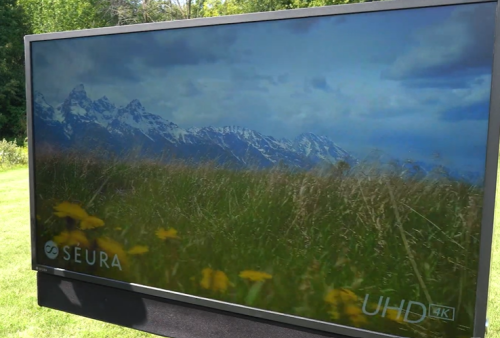
- Séura — specialty mirror TVs and waterproof TVs, engineered and built in Green Bay, WI (AllAmerican.org)2.
- MirageVision — converts brand-name TVs into weatherproof outdoor units in Las Vegas, NV — a modification, not from-scratch assembly (AllAmerican.org)2.
Reality check: even the “best case” US-assembled TV uses an imported panel, so none of these qualify for an unqualified “Made in USA” label — only, at most, a qualified “Assembled in USA” claim.
Where the big brands actually make TVs
Manufacturing and assembly locations shift constantly — brands use multiple ODM factories and move production to dodge tariffs — so treat this as “primary assembly countries,” not a fixed fact. Each row is sourced.
| Brand | Where TVs are primarily assembled | Notes / source |
|---|---|---|
| Samsung | Mexico (Tijuana), China, Vietnam; premium lines in South Korea | Tijuana plant builds Smart TVs/LCD panels (~18M units/yr capacity); ~60% of Samsung TVs reported made in China historically. Its Newberry, SC plant makes appliances, not TVs (Tecma; channelnews; Samsung Newsroom)17,18,19 |
| LG | Mexico, China, Vietnam; premium/OLED lines in South Korea | Bulk offshore; top-end assembled in South Korea (channelnews)18 |
| Sony | Mexico, China, Malaysia; some Japan | Mostly offshore; historically a majority in China. In March 2026 Sony sold a 51% stake in its Bravia TV business to TCL (channelnews; Accio)18,20 |
| TCL | China (primary), Mexico, Vietnam | Chinese brand and manufacturer; builds for itself and others (positioniseverything)21 |
| Hisense | China (primary), Mexico | Chinese brand; most sets China-built (techjunctions)22 |
| Vizio | Mexico, China, Taiwan, Thailand, Vietnam (via ODMs Foxconn, Innolux) | US-headquartered (Irvine, CA) but owns no factories — designed in USA, built offshore. Now owned by Walmart (BGR; whomakethis)23,24 |
Macro fact: by early 2025, ~65% of TVs imported into the US were assembled in Mexico, after a 2018–2024 migration of assembly out of China into Mexico and (to a lesser degree) Vietnam (Omdia)7. Sources for the table: [17] Tecma · [18] channelnews · [19] Samsung Newsroom · [20] Accio · [21] positioniseverything · [22] techjunctions · [23] BGR · [24] whomakethis. Assembly countries shift by model and year.
The tariff angle (why assembly moved, not “came home”)
Tariffs are the main reason TV assembly shifted to Mexico, not to the US. Under reciprocal-tariff math reported for 2025, TVs from China faced roughly 65% cumulative tariffs and Vietnam about 50%, while Mexico stayed at 0% under USMCA — making Mexico the obvious assembly base for the US market (Omdia)8.
But tariffs don’t fix the panel problem. Because panels are imported regardless, tariffs raise costs and push final assembly across borders — they haven’t produced a 100%-American TV. The Element saga is the cautionary tale: tariffs on Chinese parts nearly killed the one US assembly plant rather than reshoring the industry (CNN Business; Post and Courier)25,6.
If buying American-assembled matters to you
Honest, practical guidance — no false promises:
1. Reset the goal to “assembled,” not “made.” Accept up front that a 100%-US TV doesn’t exist. The realistic target is US assembly (mostly outdoor/specialty brands) or, for mainstream sets, Mexican (USMCA) assembly over Chinese.
2. For a normal living-room TV, check the box and the back-panel label for the country of origin before buying — the same model can be assembled in different countries across production runs. If you want to avoid China specifically, look for “Assembled in Mexico.”
3. For genuine US assembly, look to the outdoor/specialty niche — SunBriteTV, SkyVue, Séura, MirageVision — but expect premium pricing and know the panel is still imported (AllAmerican.org)2.
4. Read “Assembled in USA” skeptically. Ask what’s actually done domestically. The Element case shows “assembly” can mean little more than unboxing and a memory-board insert (AAM)12.
5. Ignore “Designed in USA” as an origin signal — it tells you where the engineers sit, not where the TV is built.
6. Don’t sacrifice the actual product to chase a label. Picture quality, panel type, and value should still drive the decision. If you’re shopping anyway, our buying guides pick sets that are genuinely good regardless of origin — start with the best Samsung TVs (Samsung being one of the few brands still building premium lines in its home country), the best 70-inch TVs for a big living-room screen, or the best TVs to use as monitors for a desk.
Frequently asked questions
- Are any TVs 100% made in the USA?
- No. Essentially no TV on the consumer market is 100% “Made in the USA,” and almost none can legally use that label unqualified. The reason is the display panel — a TV’s most expensive and important part — which is overwhelmingly manufactured overseas (South Korea, China, Taiwan, Japan). That single imported component puts every TV below the FTC’s “all or virtually all” US-content bar.1,2
- Which TVs are assembled in the USA?
- A small set. Most famously Element Electronics in Winnsboro, South Carolina (status worth re-verifying — see above), plus niche outdoor/specialty brands such as SkyVue (Chester, SC) and Séura (Green Bay, WI). SunBriteTV has a strong historical US-assembly story, but its current materials emphasize design/engineering rather than present-day “assembled in USA.” All of them still use imported display panels, so the strongest honest claim is “Assembled in USA,” not “Made in USA.”2,5,16
- Are Samsung and LG TVs made in America?
- No. Samsung and LG assemble the vast majority of their TVs in Mexico, China, and Vietnam, with premium and OLED lines sometimes still built in South Korea. Samsung does run a plant in Newberry, South Carolina — but it builds home appliances, not TVs. As of early 2025, about 65% of TVs imported into the US were assembled in Mexico.7,18,19
- What does “Assembled in USA” actually mean?
- Per the FTC, an unqualified “Assembled in USA” claim requires that a product’s principal assembly happens in the US, that the assembly is substantial, and that the product was last substantially transformed here. A simple “screwdriver” operation — snapping together imported parts — does not qualify. For TVs it’s the realistic best case, but it still means imported parts (especially the panel) and sometimes minimal US labor, so read it skeptically.1
- Is “Designed in USA” the same as “Made in USA”?
- No — not even close. “Designed in USA” (or “Engineered in USA”) only claims the R&D or industrial design happened here. It says nothing about where the TV is built. Vizio, for example, is designed in California but builds entirely offshore. It is not an origin claim.1,23
- Why did TV assembly move to Mexico instead of back to the US?
- Tariffs. In 2025, TVs assembled in China faced roughly 65% cumulative tariffs and Vietnam about 50%, while Mexico stayed at 0% under USMCA — so brands moved final assembly to Mexico, not the US. And because the panel is imported either way, tariffs raised costs and shifted assembly across borders without producing an American-made TV.7,8