
Best Party Speakers: Pick for the Party, Not the Wattage
Battery freedom, karaoke or a real PA setup? Five recommendations matched to the way you host—with the connections and carrying trade-offs made clear.
Atmosphere image from TPA’s existing hero library; not a photograph of any recommended model. Exact-model product photos appear below.
Choose your party speaker by power access, carrying route and input needs first. A wheeled battery speaker, a karaoke package and a mains PA cabinet solve different problems. This guide focuses on gatherings and live inputs, not pocket-size Bluetooth speakers or permanent outdoor installations.
The short answer: compare the JBL PartyBox Stage 320 for a discounted wheeled all-rounder, the PartyBox 520 for more flexible connections, and the Soundcore Rave 3S when karaoke is the point. Choose the Encore Essential 2 when you have to carry it; choose the Electro-Voice only if you want to build a mains-powered PA setup.
How we chose: manufacturer pages and manuals establish specifications; named independent reviews support the performance discussion. Recommendations are use-case judgments. No fixed prices, stock promises, crowd-size guarantees or watts-to-loudness rankings.
Five picks at a glance
Four battery-capable party speakers, then a separate mains PA option. The Stage 320 is the older-model value pick, not the newest JBL.
| Speaker | Best for | Deciding feature | Amazon / details |
|---|---|---|---|
 JBL PartyBox Stage 320 Battery + AC | Best wheeled value, if discounted | 16.5 kg; telescopic handle and wheels[2] | |
 JBL PartyBox 520 Battery + AC | Best battery pick for flexible inputs | XLR/1/4-inch combo inputs; USB-C audio[5][12] | |
 Soundcore Rave 3S Battery; USB-C charging | Best ready-to-sing karaoke package | Two wireless microphones included[4][7] | |
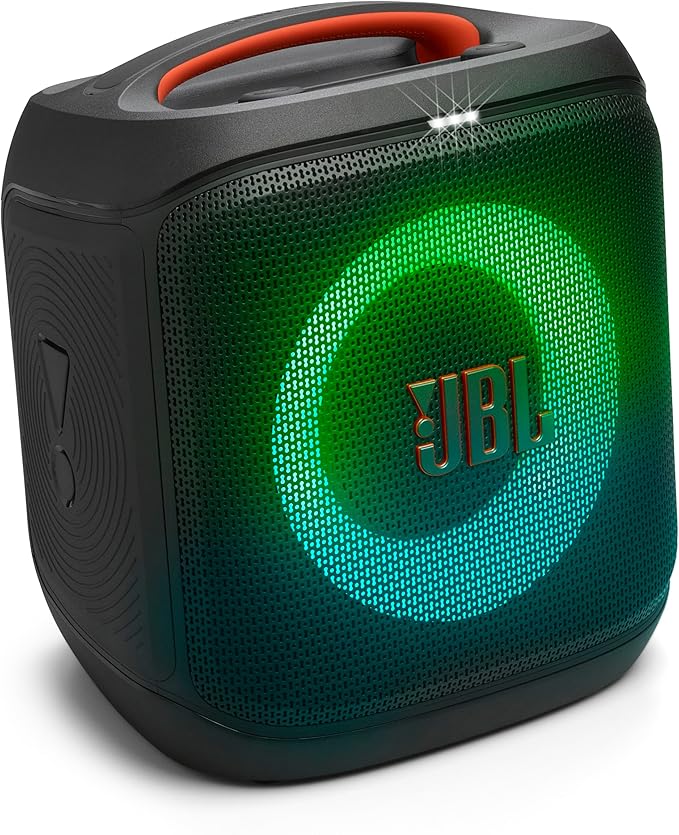 JBL PartyBox Encore Essential 2 Battery + AC | Best for a smaller party and easier carry | 6.2 kg; one shared mic/guitar input[14] | |
 Electro-Voice ZLX-12P-G2 Mains PA; no battery | Best mains-powered PA starting point | Onboard mixer; XLR/TRS inputs[10][16] |
Find your route
The specifications that change the buying decision
Battery figures below are manufacturer maximums, not same-volume comparative tests. Weights are for the speaker, not a complete event kit. On smaller screens, scroll this information table horizontally.
| Model | Weight / transport | Power / claimed runtime | Weather | Inputs | Linking |
|---|---|---|---|---|---|
| JBL PartyBox Stage 320 | 16.5 kg / 36.38 lb; wheels[13] | Up to 18 h; replaceable battery[2] | IPX4; covers closed[13] | Two 1/4-inch inputs: one mic, one mic/guitar; AUX; USB-A; wired daisy chain[6][13] | JBL Auracast; matching pair for stereo[2] |
| JBL PartyBox 520 | 25.5 kg / 56.2 lb in manual; wheels[12] | Up to 15 h; replaceable battery[1] | IPX4; covers closed[12] | Two XLR/1/4-inch combo sockets; second selectable mic/guitar/line; AUX; USB-C audio[5][12] | Two 520s for stereo; compatible JBL Auracast group[1] |
| Soundcore Rave 3S | 22 lb excluding mics; carry handle[18] | Up to 12 h, manufacturer claim[4] | IPX4 splashproof[4] | Two included wireless mics; additional 1/4-inch mic/guitar socket; AUX; USB-C charging[7] | Auracast + TWS; choose identical Rave 3S for stereo[7][18] |
| JBL PartyBox Encore Essential 2 | 6.2 kg / 13.67 lb; top handle[3][14] | Up to 15 h, manufacturer claim[3] | IPX4; covers closed[14] | One shared mic/guitar input; AUX; USB-C audio/storage (regional limits)[14] | Two Essential 2s for stereo; compatible JBL Auracast group[3] |
| Electro-Voice ZLX-12P-G2 | 14.82 kg / 32.7 lb per cabinet; pole-mountable[10] | AC mains required; no battery runtime[16] | Keep dry; manual warns against rain/moisture[16] | Two XLR/TRS combo inputs; Hi-Z option; mixer, feedback suppression and ducking[10][16] | Bluetooth stereo linking; QuickSmart app control; not JBL Auracast[10] |
- Battery caution: volume, bass processing, lights and program material change runtime. Do not turn an “up to” figure into an all-night promise.
- Weight discrepancy: JBL’s 520 page says 26 kg; its manual gives 25.5 kg. The manual value is used here.[1][12]
- Rave 3S documentation caution: the Amazon-linked “User Manual” retrieved for this listing names “Rave 3” and gives different output specifications. It was not used to establish 3S specs; the exact-model Soundcore page, brand comparison panel and independent review are the sources above.
- Pairing caution: an Auracast badge is not proof of every cross-brand or older-generation combination. Buy a matching pair if stereo is important, and confirm the exact supported models before expanding.
The picks in depth
JBL PartyBox Stage 320
The Stage 320 is the sensible starting point for a host who wants dance music, lights and occasional karaoke without hauling the largest box. SoundGuys praised its bass and room-filling presentation; RTINGS also finds useful party output, but warns that listeners at the sides or behind hear a more muffled balance.[6][8]
Its practical advantage is transport: JBL lists a 16.5 kg cabinet, wheels, a telescopic handle and a replaceable battery. The up-to-18-hour claim is a manufacturer maximum, not a promise at dance-floor volume.[2][13] Budget for a compatible microphone separately; the inputs do not mean one is included.
Buy the older model deliberately. JBL now lists a PartyBox 330 with USB-C audio and optical input.[17] The 320 remains here for its established independent evidence, not because it is the newest. Compare the actual offers: if the price gap is small or TV/karaoke connectivity matters, investigate the 330 rather than automatically buying the 320.
JBL PartyBox 520
Choose the 520 when a playlist can turn into a microphone session, a guitar performance or a DJ set. Its XLR/1/4-inch combination sockets and USB-C audio are more useful differentiators than a wattage badge; the second analog channel has a mic/guitar/line selector, so these are shared inputs, not unlimited simultaneous channels.[5][12]
SoundGuys heard strong low-end impact while vocals remained clear, and recommends the app EQ for tuning. That is the reviewer’s listening impression, not a measured loudness ranking against every speaker here.[5] JBL rates battery playback at up to 15 hours and supports a replacement battery sold separately.[1]
The trade-off is the lift. JBL’s manual specifies 25.5 kg / 56.2 lb, while its global product page rounds the metric figure to 26 kg; this guide uses the manual value.[1][12] Wheels help across a smooth floor, not into a car boot or up stairs. SoundGuys also reported a rear cover that popped open on its review unit; that is a single-unit observation, not a proven failure rate.[5]
Soundcore Rave 3S
The Rave 3S makes the strongest case when singing is the activity, not an occasional extra. Two wireless microphones are included, and the vocal-removal feature can reduce the lead singer in a normal track.[4][7] That can save more setup effort than buying a bigger speaker and assembling a separate microphone package.
SoundGuys found substantial bass with BassUp engaged and clear high-frequency details. Its reviewer also found vocal removal useful but imperfect: backing vocals could remain. Expect a fun sing-along tool, not a studio-quality instrumental stem.[7]
The wired 1/4-inch socket switches between mic and guitar, and there is a separate AUX input. SoundGuys identifies USB-C as the charging connection; do not buy it assuming a USB computer-audio interface.[7] Soundcore advertises up to 12 hours and IPX4, while its retailer-hosted brand panel lists 22 lb excluding the microphones.[4][18] It has a handle rather than the JBL towers’ trolley arrangement, so consider your carrying route.
JBL PartyBox Encore Essential 2
This is the pick when carrying the speaker is part of every event. At 6.2 kg, with a top handle, it is a different proposition from the rolling PartyBox towers.[3][14] It still has party lighting and a mic/guitar connection, rather than being another tiny travel speaker.
RTINGS found a balanced presentation with useful low bass for its size, but compression at maximum volume can reduce kick-drum punch; the sound also changes with listening angle.[11] Aim it at the gathering and leave some volume headroom instead of expecting it to do the job of the larger models.
Check the word Essential before ordering. This exact model has a single shared mic/guitar input, not two separate performance channels, and the manufacturer’s box list does not include a microphone.[3][14] JBL claims up to 15 hours; RTINGS reports over 12 hours with the ring light off, a different test condition rather than a guarantee for your party.[3][11]
Electro-Voice ZLX-12P-G2
The ZLX-12P-G2 belongs in a different lane: an active PA cabinet for wired sound reinforcement, not a battery party tower. The manufacturer specifies AC mains power; Bluetooth carries audio, not electricity.[16] Buy it for events where microphones, intelligibility and system expansion matter more than lights.
Electro-Voice provides a digital mixer, XLR/TRS inputs, feedback suppression and ducking. Phantom power is 24 V on the first XLR input only; check your microphone’s requirements rather than assuming every condenser mic will work.[10][16] Allow for suitable stands, signal cables and microphones in your total budget.
Pro Mobile used the ZLX12 G2 for a singer/guitarist and praised the vocals. Its bigger corporate-party report used a pair of tops plus a pair of EKX-18SP subwoofers; that result cannot be credited to one ZLX cabinet.[9] For bass-led dancing, audition or rent the complete PA-and-sub system in the intended space. This listing is for a speaker, not that reviewed multi-box rig.
Buy for the event you actually host
There is no useful “watts per guest” rule
A power specification is not a head-count guarantee. This guide deliberately does not rank these speakers by amplifier watts or combine one manufacturer’s maximum SPL with another outlet’s measurement. Check whether a review describes bass and clarity at higher levels, and whether the result used one speaker, a pair, or separate subwoofers.
The distinction is visible here: RTINGS describes compression reducing the Encore Essential 2’s punch at maximum volume, while Pro Mobile’s bigger EV event used separate subwoofers.[11][9]
“Best” depends on whether you need microphones
Current recommendations do not all agree. RTINGS moved its overall party pick to the Marshall Bromley 450 for balanced sound and more consistent sound around the speaker, while noting that it lacks the JBL 520’s karaoke inputs and graphic EQ.[8] Our shortlist prioritizes live inputs, setup and carrying trade-offs. If you only want music with listeners surrounding the speaker, that alternative deserves a look; this is not a claim that one JBL wins every use case.
Portability includes the awkward part of the trip
Measure the car opening and storage space, then think about stairs, grass and the final lift. A trolley handle does not remove the cabinet’s weight. The JBL 520 manual’s 25.5 kg figure is the important reality check, not its “portable” label.[12] Choose the smaller Encore if easy carrying matters more than maximum bass headroom; choose a pair or a PA only when you have the transport and setup time.
One socket cannot accept two plugs at once.
Second performer → shared second input.
The 520 adds XLR and a selectable line-input mode.
EV: PA mixer with XLR/TRS inputs; verify phantom-power requirements.
Pairing is not the same as stereo
JBL explicitly describes two matching 520s or two matching Encore Essential 2s for stereo, with compatible JBL Auracast products supporting larger groups.[1][3] Soundcore’s exact-model panel lists Auracast and TWS, and SoundGuys confirms an identical Rave 3S pair for stereo.[7][18] Do not assume old JBL TWS products, Soundcore PartyCast products or an arbitrary Auracast speaker will join your intended arrangement. Confirm the supported combination and whether wired microphones are relayed before buying a second unit.
Splash resistance does not make an outdoor installation
The battery picks carry IPX4 claims, not an immersion rating. JBL’s manuals require the protective covers to be securely closed for splash resistance.[4][12][13] Once a cable holds a cover open, plan a dry setup. Electro-Voice’s manual warns against rain and moisture; its PA cabinet belongs under a proper dry-use plan, not beside a pool.[16]
Set up once, then enjoy the party
- Rehearse the real configuration. Use the same phone, apps, microphones and cables you plan to bring. Charge the speaker and check every connection before leaving.
- Place it safely and face the audience. The JBL models discussed by RTINGS sound different off-axis; do a walk-around before increasing volume.[8][11] Keep pathways clear and follow the stand maker’s load rating.
- Start microphone gain low. Choose the correct mic/guitar/line mode, then raise the input and master levels gradually. Keep the microphone away from the speaker’s forward sound path; feedback suppression is not permission to ignore placement.[12][16]
- Check the actual music at event level. If the bass loses punch or the sound becomes strained, turn it down or reconsider the system rather than adding more bass boost.
- Plan a quiet zone and a finish time. Keep guests away from the cabinet at high volume and take listening breaks. Our Earasers vs. Eargasm comparison covers two hearing-protection options; earplugs are not a substitute for sensible levels.
For a timing-critical DJ or karaoke source, test a supported wired connection before the event.
Keep the mic out of the speaker’s forward sound path; add volume gradually.
For a larger dance rig, plan the subwoofer and coverage as part of the system—not as an afterthought.
If the party includes a film, consult our outdoor-projector speaker guide. RTINGS flags Bluetooth latency on the Encore Essential 2, so check lip sync with the actual video source before guests arrive.[11]
Looking for an older pick from this guide?
These are historical references, not extra current recommendations. The old page covered the models below; we have kept its exact destinations so existing owners can identify them. Current seller, condition, stock, support and specification accuracy are not revalidated for these older listings. Do not buy one merely because it appeared here before.
- W-KING older Bluetooth listing
- JBL PartyBox 300
- JBL PartyBox 100
- PRORECK Party 12 package
- EIFER F2-New legacy listing
- QFX SBX-412207BTBL
- Ridgeway QS-805
- Soundcore Trance
- Toshiba legacy link: TY-ASC50 URL / TY-ASC65 old text
- Norcent older pick / Xtrasaver listing
Two identity cautions: the old Toshiba prose said TY-ASC65 but linked to a TY-ASC50 URL; the old Norcent pick linked to an Xtrasaver listing. Those mismatches remain visibly labeled rather than silently turning uncertain links into endorsements. PRORECK’s bundle appeal also does not establish sound quality against the current picks.
Different jobs need different speakers
These older related guides remain useful starting points for a different project—not substitutes for a party PA.
- For a car installation: car speakers for bass and 6×9 bass speakers.
- For TV dialogue in a receiver-based system: low-profile center-channel speakers.
- For a novelty desktop gift rather than crowd sound: levitating Bluetooth speakers.
Frequently asked questions
Which party speaker should most backyard hosts start with?
Compare the JBL PartyBox Stage 320 if it is meaningfully cheaper than the newer PartyBox 330. The 320 has established independent review evidence and a wheeled design; the 330 adds USB-C audio and optical input. Choose the 520 when its extra connection flexibility is worth the heavier lift.[2][5][17]
How many watts do I need for a party?
There is no dependable watts-per-person rule. Match the venue, listening distance, desired bass and power access, then use relevant performance evidence. Do not compare a PA system with separate subwoofers against one battery speaker as if they were the same setup.[9]
Can I use a Bluetooth PA speaker without an outlet?
Only if it has a battery. The JBL and Soundcore party picks here are battery-capable, but the Electro-Voice ZLX-12P-G2 requires AC mains. Bluetooth describes an audio connection, not a power source.[1][4][16]
Can I connect a microphone and a guitar at the same time?
Check the input map. Encore Essential 2 has one shared mic/guitar socket. Stage 320 has a mic input plus a second mic/guitar input; the 520 adds XLR combo sockets and a selectable line mode. Plan around shared inputs rather than the number of features printed on the box.[12][13][14]
Are these speakers waterproof?
The four battery picks are specified as IPX4 splash-resistant, not submersible. JBL requires protective covers closed for splash resistance. The Electro-Voice PA manual warns against rain and moisture, so plan dry placement and connections.[4][12][16]
Will two different Auracast speakers work as a stereo pair?
Do not assume so. JBL specifies matching 520s or matching Encore Essential 2s for stereo, and SoundGuys describes two identical Rave 3S speakers for stereo. Group playback and left/right stereo are different features; verify the exact combination.[1][3][7]
Sources
- [1] JBL PartyBox 520 | Portable battery-powered party speaker with powerful and loud sound
- [2] JBL PartyBox Stage 320 | Portable party speaker with wheels
- [3] JBL PartyBox Encore Essential 2
- [4] soundcore Rave 3S AI Karaoke Party Speaker 200W | soundcore
- [5] JBL PartyBox 520 review: The sweet spot in JBL’s PartyBox lineup?
- [6] JBL PartyBox Stage 320 review: A portable party on wheels
- [7] Soundcore Rave 3S review: JBL PartyBox killer?
- [8] The 6 Best Speakers For Parties of 2026
- [9] The Magazine for Mobile DJs
- [10] ZLX 12P G2
- [11] JBL PartyBox Encore Essential 2 Review
- [12] JBL_PARTYBOX_520_OM_Global_EN_V4.pdf
- [13] JBL_PARTYBOX_STAGE_320_OM_Global_EN_V8.pdf
- [14] JBL_PARTYBOX_Encore_Essential_2_OM_EN_V5.pdf
- [16] ZLX-G2_UM_es
- [17] JBL PartyBox 330 | Portable party speaker with JBL legendary sound, futuristic lighting, a telescopic handle and wide wheels.
- [18] Soundcore Rave 3S – Amazon exact-model title and Soundcore comparison panel