Best Budget AV Receivers of 2026 (Top 6 Under $600)
The trap in every receiver spec sheet is power: the same amplifier gets sold as “75 watts” or “140 watts” depending on how you measure it. We print the honest FTC number for all six picks — the best value under $600 — and decode the inflated ones, with every spec cited to its source.
A great budget AV receiver shouldn’t make you overpay or over-decode a spec sheet. Two picks anchor this guide: the Denon AVR-S770H is our best overall — a 7.2-channel do-everything box with real Dolby Atmos, 8K gaming and HEOS streaming for well under $600 — and the Onkyo TX-NR5100 is our best under $400, a genuine 7.2 Atmos receiver for entry-level money. Around them sit four more: the cheapest honest path to 8K (Denon AVR-S570BT), the gamer’s THX pick (Onkyo TX-NR6100), the music-and-multiroom specialist (Yamaha RX-V4A), and the calibration step-up reviewers keep chasing (Denon AVR-X1800H).
The one thing to understand before you spend: receiver power ratings are gamed. US manufacturers publish an honest FTC number — full bandwidth, two channels driven — but the eye-popping figures you see in ads use an easier 6-ohm, 1 kHz, single-channel method. Denon’s own materials rate the S770H at both “75 W” and “140 W” — same amplifier. We print the honest FTC figure for every pick and label each one (mfr spec), then decode the inflated numbers below. We rank these on published manufacturer specifications and the consensus of independent professional reviews and long-term owner reports, with every spec cited to its source — and when you’re ready to move past the budget tier, see our full guide to the best AV receivers.
The picks at a glance
Six receivers from about $330 to $850 — every power figure is the honest FTC rating, cited. Compare them here, then jump to any full write-up below.
| Receiver | Best for | Standout (cited) | Get it |
|---|---|---|---|
 Denon AVR-S770H 7.2ch · Atmos | Best overallDo-it-all under $600 | 7.2ch · 75 W (8Ω, 0.08% THD, 2ch — mfr) · real Atmos & 8K | |
 Denon AVR-S570BT 5.2ch · 8K | Best valueCheapest 8K, first 5.1 | 4 HDMI in, all 8K · eARC 40 Gbps · Wirecutter budget pick | |
 Onkyo TX-NR6100 7.2ch · THX | Best for gamingPS5/Xbox, THX movies | THX Certified · VRR/ALLM/QFT/QMS on HDMI 2.1 · CNET #1 | |
 Onkyo TX-NR5100 7.2ch · Atmos | Best under $400Value 7.2 Atmos | 7.2ch Atmos + 8K · 80 W (8Ω, FTC — mfr) for entry money | |
 Yamaha RX-V4A 5.2ch · MusicCast | Best for musicMusic-first, multiroom | MusicCast + YPAO · clean 2ch, 80 W (6Ω, FTC — mfr) | |
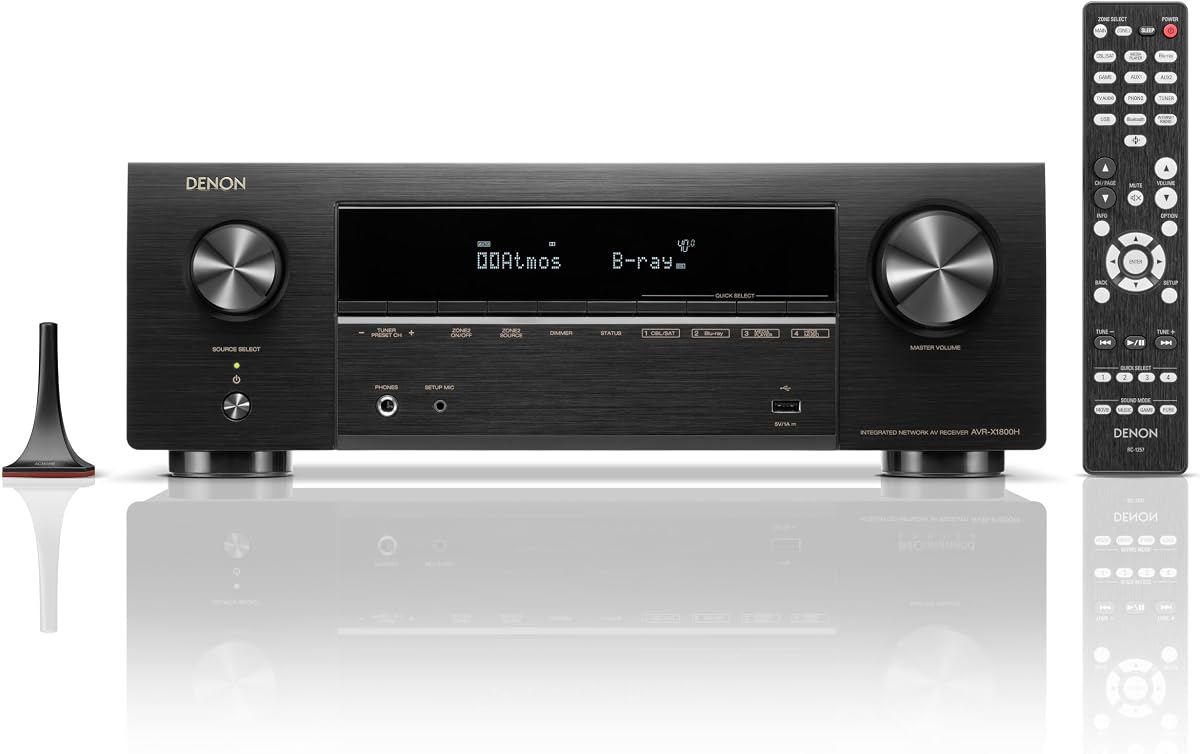 Denon AVR-X1800H 7.2ch · MultEQ XT | Best step-upProblem rooms, calibration | Audyssey MultEQ XT · Wirecutter #1 overall |
Which budget AV receiver is right for you?
Skip the spec overwhelm — match your situation to the pick.

The honest spec sheet, side by side
Every power figure is the manufacturer’s FTC rating with its measurement condition printed in full — no marketing math. Want to line up any two head-to-head? Use our comparison hub.
| Receiver | Channels | Power/ch (with condition) | HDMI 2.1 (8K / 4K120) inputs | Room correction | Dolby Atmos |
|---|---|---|---|---|---|
| Denon AVR-S770H | 7.2 | 75 W (8Ω, 20 Hz–20 kHz, 0.08% THD, 2ch driven — mfr spec)¹ | 3 of 6 | Audyssey MultEQ | Yes (5.2.2) |
| Denon AVR-S570BT | 5.2 | 70 W (condition unstated — mfr spec)⁴ | 4 of 4 (all 8K) | None | No |
| Onkyo TX-NR6100 | 7.2 | 100 W (8Ω, 20 Hz–20 kHz, 0.08% THD, 2ch, FTC — mfr spec)² | 3 of 6 (+VRR/ALLM/QFT/QMS) | AccuEQ + AccuReflex | Yes (5.2.2) |
| Onkyo TX-NR5100 | 7.2 | 80 W (8Ω, 20 Hz–20 kHz, 0.08% THD, 2ch, FTC — mfr spec)² | 8K/60 & 4K/120 (input count unconfirmed)⁵ | AccuEQ + AccuReflex | Yes (5.2.2) |
| Yamaha RX-V4A | 5.2 | 80 W (6Ω, 20 Hz–20 kHz, 0.06% THD, 2ch, FTC — mfr spec)³ | 1 of 4 | YPAO | No |
| Denon AVR-X1800H | 7.2 | 80 W (8Ω, 20 Hz–20 kHz, 0.08% THD, 2ch — mfr spec)¹⁶ | 3 of 6 | Audyssey MultEQ XT | Yes (5.2.2) |
| Sony STR-DH790 (honorable mention) | 7.2 | 145 W (6Ω, 1 kHz, 1ch — inflated method, mfr spec)⁷ | 0 (4K/60 only) | Adv. D.C.A.C. | Yes (5.1.2) |
- Every honest figure is a two-channels-driven rating: drive all channels at once — which is exactly what an Atmos movie does — and each receiver here makes less than its printed number. The Audioholics 2026 buying guide warns these ratings “often don’t reflect real-world output.”⁷
- The “140 W” and “165 W” you see elsewhere aren’t bigger amps: they’re the same amplifiers measured the easy way — 6Ω, 1 kHz, one channel driven (or at high THD). They aren’t comparable to the FTC figures above, so we don’t print them as if they were.
- Sony’s 145 W uses that inflated method: its real two-channel output is roughly ~90 W. We keep it as an honorable mention because it’s 4K/60 only — no 8K, no HDMI 2.1 gaming features.⁷
- Denon lists the S570BT at “70 W” with no stated condition: no load, THD or channels-driven figure. Rather than invent one, we print it plainly — treat it as a conservative Denon rating.⁴
- We won’t print a specific 8K-input count for the Onkyo TX-NR5100: Onkyo’s current spec page confirms 8K/60 & 4K/120 with VRR/ALLM/QFT, but the exact number of 8K inputs wasn’t stated in what we captured (it’s commonly reported as three of six — confirm before you rely on it).⁵
Sources: ¹ Denon US infosheets — AVR-S770H & AVR-X1800H (FTC 8Ω, 2ch driven) · ² Onkyo spec pages — TX-NR6100 & TX-NR5100 (FTC 8Ω, 2ch) · ³ Yamaha USA — RX-V4A (6Ω, 2ch, FTC) · ⁴ Denon — AVR-S570BT product page (70 W, load unstated) · ⁵ Onkyo — TX-NR5100 spec page (8K/60 & 4K/120; input count not stated in capture) · ⁶ Crutchfield — AVR-X1800H (“80 watts per channel, 2 channels driven”) · ⁷ Sony — STR-DH790 spec; Audioholics — Ultimate Dolby Atmos AV Receiver Buying Guide 2026 (all-channels-driven output is lower; marketing watts “often don’t reflect real-world output”). Prices move — check current price before buying.
The six picks, in depth
Denon AVR-S770H — 7.2ch, real Atmos & 8K
The S770H is the budget receiver that cuts the fewest corners. It’s a 7.2-channel design that drives a 5.2.2 Dolby Atmos or DTS:X layout, rated 75 W per channel (8Ω, 20 Hz–20 kHz, 0.08% THD, 2 channels driven — mfr spec) (Denon). Ignore the “140 W” you’ll see on Denon’s global page — that’s the same amplifier measured the easy way, at 6Ω and 1 kHz with a single channel driven. Six HDMI inputs, three of them full 8K/60 and 4K/120 (HDMI 2.1), one output with eARC, Audyssey MultEQ room correction, and HEOS multiroom with AirPlay 2 round out a genuinely complete feature set for well under $600.
It’s the box we’d hand most people: nothing here is missing that a budget home theater actually needs. Pair it with a capable subwoofer — the “.2” means two independent sub outputs — for the single biggest upgrade to a budget system (see our best subwoofers under $1,000).
Denon AVR-S570BT — the cheapest honest 8K
The least expensive path to full 8K and a clean 5.2 system, and Wirecutter’s named budget pick (Wirecutter). It’s a 5.2-channel receiver with no Dolby Atmos (there are no amplified height channels), rated 70 W per channel — and here we’ll be precise: Denon publishes “70 Watts per Channel” without stating the load, THD or channels driven, so we print it plainly and don’t dress it up with a condition it doesn’t state (mfr spec) (Denon). Where it punches above its price is video: four HDMI inputs, all 8K, one output with eARC up to 40 Gbps, and the full HDR stack (HDR10, HDR10+, Dolby Vision, HLG).
The catch is what’s missing — no Wi-Fi or app streaming (Bluetooth only) and no onboard room correction. If you want any of that, the Onkyo TX-NR5100 is a step up for similar money. But for a first 5.1 system where the goal is 8K passthrough for the least money, nothing here is cheaper. Building the whole room? See our best budget home theater systems.
Onkyo TX-NR6100 — the THX gamer’s pick
CNET’s overall #1 AV receiver, and the fullest HDMI 2.1 gaming stack in the budget tier (CNET). It’s a 7.2-channel receiver with 5.2.2 Dolby Atmos and DTS:X, rated 100 W per channel (8Ω, 20 Hz–20 kHz, 0.08% THD, 2 channels driven, FTC — mfr spec) (Onkyo) — the highest honest rating here, and CNET independently lists the same 100 W. Its gaming stack leads the group: six HDMI inputs with inputs 1–3 doing 8K/60 and 4K/120 plus VRR, ALLM, QFT and QMS, and eARC.
Room correction is AccuEQ with AccuReflex and subwoofer EQ — Onkyo’s current materials list AccuEQ for the 6100, so that’s what we cite. Streaming is broad (works with Sonos, Chromecast built-in, AirPlay 2 and DTS Play-Fi over dual-band Wi-Fi), and THX certification with four listening modes seals it for movie night.
Onkyo TX-NR5100 — a real 7.2 Atmos box for entry money
More receiver than the price suggests, and our best pick under $400. It runs 5.2.2 Dolby Atmos and DTS:X plus Height Virtualizer, rated 80 W per channel (8Ω, 20 Hz–20 kHz, 0.08% THD, 2 channels driven, FTC — mfr spec) (Onkyo). A third-party review found Onkyo’s marketing figure quoted as “165 W” at 6Ω, 1 kHz and 10% THD — a textbook inflated rating; the 80 W FTC number is the honest one.
HDMI 2.1 covers 8K/60 and 4K/120 with HDR10+, Dolby Vision, VRR, ALLM, QFT and eARC on the main output — though we won’t print a specific 8K-input count, because the Onkyo spec page we cited doesn’t state one (it’s commonly reported as three of six; confirm before you rely on it). Room correction is AccuEQ with AccuReflex; it is not THX certified — THX starts at the 6100.
Yamaha RX-V4A — the music-first pick
Clean two-channel sound plus Yamaha’s MusicCast whole-home streaming — the budget pick for a music-led system, if you don’t need Atmos. It’s a 5.2-channel receiver with no Dolby Atmos or DTS:X, rated 80 W per channel (6Ω, 20 Hz–20 kHz, 0.06% THD, 2 channels driven, FTC method — mfr spec) (Yamaha). Note the load: it’s 6 ohms, not 8 — a detail some spec tables get wrong. It decodes Dolby TrueHD, Dolby Digital Plus and DTS-HD Master Audio, with Yamaha’s Cinema DSP programs.
Connectivity is four HDMI inputs with one supporting 8K/60 and 4K/120, plus YPAO room correction, MusicCast multiroom, AirPlay 2, Spotify Connect, Wi-Fi and Bluetooth. If your system is music-led and already on MusicCast, this wins; for a movie-first Atmos room it doesn’t. Prefer to skip speaker wire entirely? See our best wireless home theater systems.
Denon AVR-X1800H — the calibration upgrade worth the stretch
The receiver reviewers most often say is worth the stretch — and now Wirecutter’s outright #1 AV receiver (Wirecutter). It replaces the discontinued AVR-X1700H that older guides recommended. It’s a 7.2-channel Atmos receiver rated 80 W per channel (8Ω, 20 Hz–20 kHz, 0.08% THD — mfr spec) (Denon), with Crutchfield independently confirming “80 watts per channel (2 channels driven)” (Crutchfield). Six HDMI inputs (three 8K), one output with eARC.
The headline reason to pay up is Audyssey MultEQ XT — it measures more points than the MultEQ in cheaper Denons, and Wirecutter’s testers call it “a clear winner over alternatives from other manufacturers.” It is not meaningfully more powerful than the S770H (80 vs 75 W, mfr spec); you’re paying for calibration and build, not volume. One honest caveat: its street price is volatile — MSRP is $849, and while it often falls to ~$599–649 it can sit near $850 or go out of stock. If it’s near $850, the S770H is the better value.
Watts decoded: why one receiver shows two very different power numbers
Here’s the single most misleading number on any receiver box. In the US, manufacturers publish an honest FTC full-bandwidth, two-channels-driven rating — measured across the whole audible range (20 Hz–20 kHz), into 8 ohms, at low distortion, with two channels working at once. That’s the number we print for every pick, labeled (mfr spec). The eye-popping figures you see in ads — “140 W,” “165 W” — come from an easier test: 6 ohms, a single 1 kHz tone, often one channel driven, sometimes at high distortion. Same amplifier, friendlier conditions, bigger number.
The gap is real and it’s large. Denon rates the AVR-S770H at 75 W the honest way and 140 W the marketing way. Onkyo’s TX-NR5100 is 80 W FTC against a “165 W” marketing figure. And there’s a further catch even the FTC number understates: it’s a two-channels-driven rating, but a Dolby Atmos movie drives five, seven or nine channels at once — so real per-channel output during a busy scene is lower still. The Audioholics 2026 buying guide puts it bluntly: these ratings “often don’t reflect real-world output” (Audioholics). The good news: for small-to-medium rooms, every receiver here has ample power. Chase clean watts and calibration, not the biggest sticker number.
How much power — and how many channels — your room actually needs
Match the receiver to the room, not the sticker. A small den running a 5.1 set is well served by 70–80 W of honest power — the Denon AVR-S570BT or Onkyo TX-NR5100 have plenty. A typical medium living room stepping up to a 5.2.2 Atmos layout wants a bit more headroom and real height channels; that’s the Denon AVR-S770H or Onkyo TX-NR6100 zone. A large or open-plan space is the one place raw watts and good calibration genuinely earn their keep — because all-channels-driven output falls below the two-channel rating, you want the extra margin of the 100 W THX-certified TX-NR6100, or the smoother auto-EQ of the X1800H’s MultEQ XT.
The budget ladder, and how room correction climbs it
From about $330 to $850, more money mostly buys three things: channels (5.2 → 7.2, which is what unlocks Atmos), streaming, and — the one worth paying for — better room correction. Room correction matters more than raw watts, because it fixes the boomy bass and harsh reflections your room adds. The ladder runs roughly: Onkyo AccuEQ (on both NR receivers) and Yamaha YPAO at the value end; Denon Audyssey MultEQ on the S770H; and Denon Audyssey MultEQ XT on the X1800H, which measures more points and is the system Wirecutter’s testers single out. If your room is acoustically difficult, MultEQ XT is the upgrade worth the stretch; if it’s well-behaved, the cheaper tiers are fine.
8K, HDMI 2.1 and 4K/120: what’s real and what’s future-proofing
For most buyers, 8K passthrough is future-proofing — there’s very little 8K content to watch today. The real, usable benefit is the HDMI 2.1 gaming stack that ships alongside it: 4K/120, VRR and ALLM are what a PS5, Xbox Series X or gaming PC actually uses. If you game, that’s the reason to prioritize the Onkyo TX-NR6100, which runs VRR/ALLM/QFT/QMS across three inputs. If you don’t game, don’t overpay for ports you’ll never use — a couple of 8K/4K120 inputs is plenty.
Two more things worth getting right. First, count your ports against your sources: the Denon S770H, X1800H and Onkyo TX-NR6100 give you three 8K/4K120 inputs, the Denon S570BT gives four all-8K inputs, and the Yamaha RX-V4A gives just one — fine for a single console, tight if you have several. Second, whatever you buy, use certified HDMI 2.1 (48 Gbps) cables and confirm eARC on both the receiver and your TV; cheap cables silently cap you below 4K/120, and eARC is what carries the lossless Atmos soundtrack. Not ready for a full receiver-and-speakers build? A Dolby Atmos soundbar is a simpler path, and a passive soundbar driven by one of these receivers is a tidy middle ground.
Complete your budget system
A receiver is the brain of a home theater — but it’s only as good as what you plug into it. A few companion buys make the biggest difference on a budget:
- 🔊 A subwoofer — the “.2” in 7.2/5.2 means two sub outputs; a good sub is the single biggest upgrade to a budget system → our best subwoofers under $1,000
- 📦 A speaker package — pair the receiver with an affordable set → our best budget home theater systems
- 🎬 A simpler path — not ready for receiver-and-speakers? A Dolby Atmos soundbar does most of it in one box → our best Dolby Atmos soundbars
- 🔇 No speaker wire — want to avoid running cable? → our best wireless home theater systems
- 🔈 A passive soundbar — prefer one driven by your receiver? → our best passive soundbars
And remember the two cables that quietly make or break the setup: certified HDMI 2.1 (48 Gbps) for full 4K/120, and an eARC connection between the receiver and your TV for lossless Atmos.
Catch these receivers on sale
AV receivers go on deep discount more often than you’d think, and model-year churn means today’s pick is next season’s clearance. Join our Deal Alerts and we’ll email you the genuinely good AV deals and honest buying tips — no spam, unsubscribe anytime.
Double opt-in, so confirm via the email we send. No spam — just real deals and useful AV advice.
Frequently asked questions
- Do budget AV receivers really support Dolby Atmos?
- Some do, some don’t — it depends on channel count. The 7.2-channel picks (Denon AVR-S770H and AVR-X1800H, Onkyo TX-NR5100 and TX-NR6100) decode Atmos in a 5.2.2 layout; the 5.2-channel Denon AVR-S570BT and Yamaha RX-V4A do not, because they lack the extra amplified height channels.
- How many watts do I actually need — and why don’t the numbers match between brands?
- Fewer than the spec sheets imply. US brands publish an honest FTC full-bandwidth, two-channels-driven figure (e.g., the Onkyo TX-NR6100 at 100 W into 8Ω, 20 Hz–20 kHz, 0.08% THD — mfr spec); the eye-popping “140 W / 165 W” numbers come from a 6-ohm, 1 kHz, single-channel method. Audioholics notes these ratings “often don’t reflect real-world output.” For small-to-medium rooms, every receiver here has ample power.
- Is 8K HDMI worth it, or is 4K enough?
- For most buyers, 8K passthrough is future-proofing — there’s little 8K content today. But the HDMI 2.1 gaming features that ship alongside it (4K/120, VRR, ALLM) are the real benefit for PS5 and Xbox Series X owners. If you game, prioritize the Onkyo TX-NR6100 (VRR/ALLM/QFT/QMS on three inputs). If you don’t, a 4K-only receiver still delivers Atmos for less — that’s the niche the older Sony STR-DH790 fills.
- Which room-correction system is best in this price range?
- Room correction matters more than raw watts. Audyssey MultEQ XT (Denon AVR-X1800H) measures more points and, per Wirecutter’s testers, beats lesser calibration systems; the S770H uses the simpler MultEQ, and the Onkyos use AccuEQ. If your room is acoustically difficult, the X1800H’s MultEQ XT is the upgrade worth paying for.
- The Denon AVR-X1700H is cheaper — should I get that instead of the X1800H?
- The X1700H (2021) has been replaced by the X1800H (2023), which is Denon’s current model and Wirecutter’s #1 overall. Feature sets are close; buy the X1800H unless a genuinely discounted, in-stock X1700H appears. Don’t pay a premium for the older unit.
- Do I need the receiver’s dual subwoofer outputs?
- The “.2” in “7.2” or “5.2” means two independent subwoofer outputs — useful for smoother bass across seats. Even the entry picks include them. Pairing with a capable sub is the biggest single upgrade to a budget system — see our best subwoofers under $1,000.