The Best 85-Inch TV in 2026 (and the honest truth about the size)
85 inches is a real, mass-produced class — so you’re choosing between genuine flagships. The catch most lists won’t say: at this size, Mini-LED is the smarter buy for most rooms than OLED. Here’s why, with cited lab specs.
An 85-inch TV is no longer an exotic splurge — it’s a mainstream size, which is good news: you’re choosing between genuinely great panels from Samsung, Sony, TCL, Hisense, and LG, not settling for an oddball. But “85-inch” hides a few traps. The biggest: true 85-inch OLED essentially doesn’t exist. LG and Samsung make their large OLEDs at 83 inches, then jump to 88 or 97 — so when a list says “buy this 85-inch OLED,” check the fine print, because it’s almost certainly an 83-inch panel (the genuine 85- and 86-inch sets from TCL are Mini-LED, not OLED). We say the size out loud on every pick.
The second trap is assuming the priciest technology is the right one at this size. It usually isn’t. An 85-inch TV tends to live in a big, bright room watched from across that room — exactly where Mini-LED’s brightness matters most and OLED’s perfect blacks matter least. A Hisense U8QG punches around 4,000 nits (Tom’s Guide, measured on the 65-inch) for a fraction of an OLED that size. So this guide is organized by how you’ll actually use the TV — and every brightness number names its source, picture mode, and the exact screen size the lab tested. Every figure is attributed to the lab that produced it. On top of that, we own and use the 83-inch LG G5.
The picks at a glance
Six TVs across every use case and budget — compare them at a glance, then jump to any full review below.
| TV | Best for | Standout (measured) | Get it |
|---|---|---|---|
 Samsung QN90F (85″) Neo QLED · Mini-LED | Best overallBright-room all-rounder | ~2,500 nits HDR · 4× HDMI 2.1 · 165Hz | |
 LG G5 (83″) RGB Tandem OLED | 🟢 Best premium OLEDWe own & use it | ~2,400+ nits · infinite blacks · Dolby Vision | |
 Hisense U8QG (85″) Mini-LED | Best for bright roomsBeats glare | ~3,900–4,000 nits — brightest here | |
 TCL QM8K (85″) QD-Mini-LED | Best for gamingTested at 85″ | 5.2ms lag · 144Hz · the one lab-tested at 85″ | |
 Hisense U7 / U75QG (85″) Mini-LED | Best value~80% of flagship | ~3,000 nits · 4× HDMI 2.1 · 165Hz | |
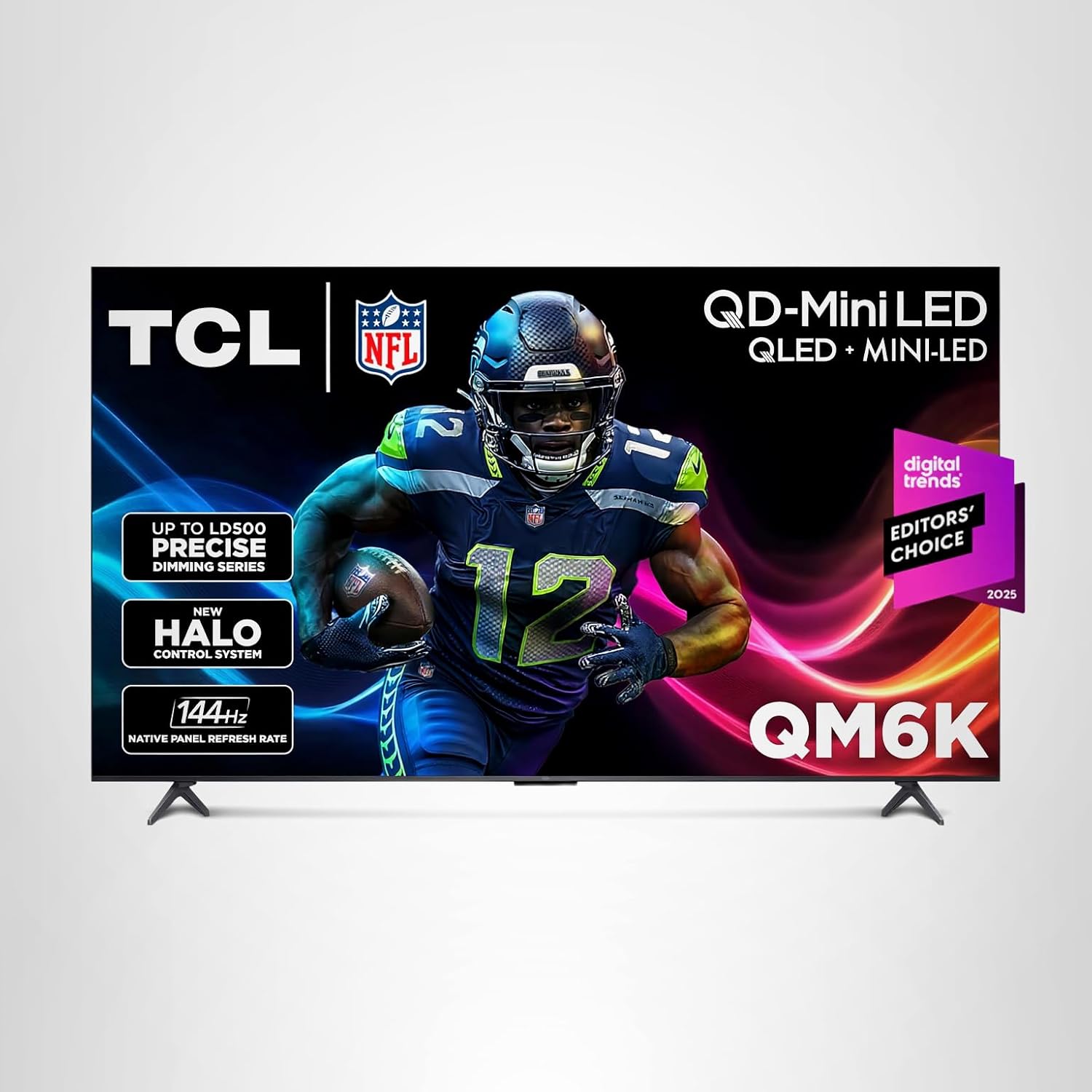 TCL QM6K (85″) QD-Mini-LED | Best giant-screen valueCheapest true 85″ | 144Hz · QD-Mini-LED · lowest-cost real 85″ |
Which 85-inch TV is right for you?
Skip the spec overwhelm — match your situation to the pick.

Measured 85-class picture vs. the marketing
Every figure is from an independent lab, footnoted (here’s how we test and pick, and who we are) — and measured on the size noted. Only the TCL QM8K was lab-tested at a true 85″; the rest are measured off-size, because most labs review the 65″.
| TV | Panel | Peak HDR (10%) | Black / contrast | Gaming (lag · HDMI 2.1) | Dolby Vision | Measured on |
|---|---|---|---|---|---|---|
| Samsung QN90F (85″) | Mini-LED · VA | ~2,500 nits¹ | Strong dimming; can bloom | ~9.5–9.8ms · 4× (165Hz)¹² | No (HDR10+) | 65″¹ (RTINGS 75″)² |
| LG G5 (83″) 🟢 | RGB Tandem OLED | ~2,400+³ / 2,268 FMM⁴ | 0 (infinite)³ | 9.2–12.9ms (4K/60)⁴ · 4× (165Hz)³ | Yes | RTINGS 77″³ / TR 65″⁴ |
| Hisense U8QG (85″) | Mini-LED · VA | ~3,900–4,000⁶ | Strong dimming; some bloom | 9.7ms · 3× (165Hz)⁶ | Yes (+HDR10+) | 65″⁶ |
| TCL QM8K (85″) | QD-Mini-LED · VA | ~2,752 FMM⁸; ~1,400 real-scene @85″⁹ | 6,470:1 native @85″⁹; FALD, blooms | 5.2ms · 2× (144Hz)⁷ | Yes (+HDR10+) | 85″⁹ + 65″⁷⁸ |
| Hisense U7 / U75QG (85″) | Mini-LED · VA | ~3,000; ~1,800 real-scene¹⁰ | Strong dimming; some bloom | ~5ms · 4× (165Hz)¹⁰ | Yes (+HDR10+) | 65″¹⁰ |
| TCL QM6K (85″) | QD-Mini-LED · VA | ~560–812 (unit-variable)¹¹¹² | ~6,000:1; FALD ~500 zones | ~13ms · 2× (144Hz)¹¹ | Yes (+HDR10+) | 65″¹¹ / 75″¹² |
- “Peak nits” is a best-case window, not what you’ll usually see: these are roughly 10% white-window figures. Real content runs dimmer — TCL’s own QM8K measures ~2,752 nits peak but only ~1,400 nits on a real scene at 85″⁸⁹. Treat the big numbers as ceilings.
- Almost nobody tested the 85″: only the TCL QM8K was lab-measured at a true 85″⁹ — every other figure here is from the 65″ (or 75″/77″). Bigger panels typically run equal or slightly dimmer than their smaller siblings, not brighter, so don’t expect the 85″ to beat these numbers.
- Mini-LED “native contrast” understates real performance: figures like the QM8K’s 6,470:1⁹ are panel-only — full-array local dimming lifts in-scene contrast well beyond that, at the cost of some blooming around bright objects. OLED is simply infinite. (More on that trade-off: OLED vs QLED.)
- The TCL QM6K is a panel lottery on brightness: one unit measured ~812 nits (AVS Forum, 65″), another ~560–695 nits (TechRadar, 75″)¹¹¹² — so we quote a range, not a hero number. It’s a value giant, not a bright-room TV.
- Dolby Vision divides this group: Samsung’s QN90F is HDR10+ only — everything else here supports Dolby Vision plus HDR10+.
Sources: [1] Expert Reviews, QN90F · [2] What Hi-Fi / RTINGS, QN90F · [3] RTINGS, LG G5 · [4] TechRadar / Tom’s Guide, LG G5 (Bodnar 4K/60 lag: 9.2ms Boost / 12.9ms) · [5] TechRadar, 83″ G5 impressions · [6] Tom’s Guide, U8QG · [7] What Hi-Fi, QM8K · [8] Tom’s Guide / CE-Sphere, QM8K · [9] Digital Trends, QM8K (the one 85″ test) · [10] TechRadar, U75QG · [11] AVS Forum, QM6K · [12] TechRadar, QM6K. RTINGS’ exact figures are paywalled; we cite only labs that publish their tables.
The six picks, in depth
Samsung QN90F (85″) — Neo QLED / Mini-LED
The QN90F earns “best overall” the same way a great all-rounder always does: it’s excellent at everything rather than spiking on one number. Its Mini-LED panel pairs strong contrast with roughly 2,500 nits of HDR brightness in Expert Reviews’ measurement (on the 65″)¹, so it stays punchy in the kind of bright, open room an 85-inch TV usually lives in. What separates it from the cheaper Mini-LEDs is the complete package: the widest gaming support here — four HDMI 2.1 ports, up to 165Hz, and FreeSync Premium Pro, with What Hi-Fi noting fast sub-10ms input lag² — plus Samsung’s Tizen platform and class-leading motion and upscaling.
Two honest caveats. It’s HDR10+ only — no Dolby Vision, which a lot of streaming content uses. And as a VA Mini-LED it can bloom in dark scenes and its real strength is brightness, not the absolute blacks an OLED delivers. Samsung builds it as a true 85″, so the size is genuine — no asterisk needed.
LG G5 (83″) — RGB Tandem OLED
Most picks here we assess from lab data. This one we’ve lived with: we own and run the 83-inch G5 in our own setup, which is exactly the size you’d buy in this guide (a true 85″ OLED doesn’t exist — LG goes 83″ then 97″). What surprises everyone who sees it is the brightness: it is startlingly bright for an OLED, holding up in a room with windows in a way older OLEDs never could, while keeping the inky, per-pixel blacks no Mini-LED can match. The lab numbers back the eyes — RTINGS measured roughly 2,400+ nits of peak HDR on the G5³, and TechRadar clocked about 2,268 nits on a full-measurement window⁴ — on a panel whose blacks are simply infinite³. TechRadar’s own hands-on with the 83-inch reached the same verdict: bright enough to make projectors feel obsolete⁵.
For a mixed movie-and-gaming household the connectivity is the best of any OLED here: four HDMI 2.1 ports, up to 165Hz, with G-Sync and FreeSync³, and input lag of 9.2ms (Boost) to 12.9ms on the Bodnar 4K/60 bench (Tom’s Guide; TechRadar’s meter agrees at 9.2ms)⁴. It supports Dolby Vision (plus HDR10 and HLG) — though, like all LG OLEDs, not HDR10+.
Hisense U8QG (85″) — Mini-LED
If your room is flooded with light, the U8QG is the answer and it isn’t close. Tom’s Guide measured roughly 3,900–4,000 nits of peak HDR and about 2,908 nits in a 10% SDR window on the 65-inch⁶, so even midday TV with the blinds open stays vivid — and it’s the brightness-per-dollar champ at this size, landing around half the price of an OLED this big. It handles both HDR formats (Dolby Vision and HDR10+), runs a 165Hz panel, and games well at about 9.7ms of lag⁶.
The trade-offs are real and worth saying plainly. It has only three HDMI 2.1 ports (and one is a shared USB-C), one fewer than the QN90F and U7⁶; as a VA Mini-LED it can bloom in dark scenes and its viewing angle is narrow; and remember the brightness figures are from the 65″ — the 85″ will be in the same ballpark, not brighter.
TCL QM8K (85″) — QD-Mini-LED
This is the one pick in the guide a lab actually measured at a true 85 inches, which makes it the rare set where we’re not extrapolating from a smaller panel. What Hi-Fi clocked near-instant 5.2ms input lag at 4K/120 (on the 65″)⁷, on a native 144Hz panel with FreeSync Premium Pro, ALLM, and Dolby Vision gaming — a complete gaming kit on a giant screen. Brightness is genuinely reference-class too: Tom’s Guide and CE-Sphere measured around 2,752 nits peak⁸, and crucially Digital Trends tested the actual 85-inch at about 1,400 nits on real scenes with 6,470:1 native contrast before local dimming⁹ — a useful reality check on what the big peak numbers mean in practice.
One honest gaming caveat from the testing: if you crank local dimming to its highest setting for the best contrast, input lag roughly doubles to around 30ms (FlatpanelsHD) — so competitive players will leave dimming lower. And like every VA Mini-LED here it can bloom in dark scenes. It’s a giant, bright, low-lag screen without a premium badge — that’s the whole pitch.
Hisense U7 (85U75QG, 85″) — Mini-LED
The U7 is the value sweet spot: it gives you roughly 80% of the flagship experience for meaningfully less money. TechRadar measured about 3,000 nits of peak HDR and around 1,800 nits on real scenes (on the 65″)¹⁰ — not quite U8QG-bright, but more than enough to handle a sunny room — with both HDR formats (Dolby Vision and HDR10+). For gaming it actually one-ups its pricier sibling: it carries the full four HDMI 2.1 ports, a 165Hz panel, and very low ~5ms input lag at 4K/120¹⁰.
The compromises are the expected ones for the price. It doesn’t reach the U8QG’s brightness or its more aggressive local dimming, so highlights and dark-scene contrast aren’t quite as strong, and as a VA Mini-LED it shares the same off-angle and blooming caveats. But on a dollar-for-dollar basis, for a bright, gaming-capable 85-inch screen, it’s the smart-money pick.
TCL QM6K (85″) — QD-Mini-LED
The QM6K is the lowest-cost path to a real 85-inch screen, full stop — and for “bigger is better” on a budget, that’s the whole point. It’s a genuine QD-Mini-LED with full-array local dimming (~500 zones and roughly 6,000:1 contrast), a native 144Hz panel with FreeSync, and both HDR formats (Dolby Vision and HDR10+)¹¹. For a dim-to-moderate room watching movies and everyday TV, it delivers a huge, modern picture for less than anything else here.
Be clear-eyed about the cut corners — chiefly brightness, which is also a bit of a unit lottery: one review measured about 812 nits peak (AVS Forum, 65″) and another roughly 560–695 nits (TechRadar, 75″)¹¹¹², so we quote a range rather than a single hero figure. Either way, in a bright room those highlights look flat. Input lag is a middling ~13ms at 4K/120 as well¹¹. This is a screen-size-per-dollar play, not a performance one.
Is there really no 85-inch OLED?
Correct — and it’s the single most important thing to understand before you shop this size. Unlike 60 or 70 inches, 85 inches is a real, mass-produced class: Samsung, Sony, TCL, and Hisense all build genuine 85-inch panels, so you’re choosing between actual flagships, not oddball leftovers. The one technology that skips it is OLED. LG and Samsung make their large OLEDs at 83 inches, then jump straight to 88 or 97 — there’s no 85-inch OLED in between. So when a list tells you to “buy this 85-inch OLED,” it’s almost always pointing at an 83-inch panel. The true 85- and 86-inch sets you’ll find (TCL’s QM6K, QM8K and the rest) are Mini-LED, not OLED.
That leads to the bigger, counter-intuitive point: at this size, Mini-LED is usually the smarter buy than OLED. An 85-inch TV almost always lives in a big room, watched from across that room, and often with windows. That’s exactly the environment where Mini-LED’s enormous brightness earns its keep and OLED’s perfect blacks are hardest to appreciate — you’re rarely sitting in a pitch-black theater six feet away. A Hisense U8QG pushes around 4,000 nits for a fraction of what an 83-inch OLED costs. OLED still wins in a dedicated dark room where contrast is everything — that’s why the 83″ LG G5 is here — but for most 85-inch buyers, the bright-room math favors Mini-LED.
83 vs 85 vs 86 inches: don’t overthink it. From a normal viewing distance the size difference between them is negligible — a couple of inches on the diagonal you won’t notice from the couch. Choose by technology and price, not the exact number: 83″ gets you OLED, 85″ gets you the brightest Mini-LED and QLED flagships, and 86″ is effectively the same as 85″.
Want a different size? We’ve also got guides to the best 80-inch TVs, and if 85 is too big for your space, the best 70-inch TVs and best 60-inch TVs — plus the best Samsung TVs overall (the QN90F is a star there too).
Size & viewing distance
4K lets you sit closer without seeing pixels, but an 85-inch screen is genuinely large, so give it room. A comfortable distance lands roughly between 8.5 and 11 feet — a useful rule of thumb is about the screen size times 1.2 in inches, converted to feet.
| Screen size | Comfortable 4K viewing distance |
|---|---|
| 83″ | ~8 – 10.5 ft |
| 85″ | ~8.5 – 11 ft |
| 86″ | ~8.5 – 11 ft |
If your couch is 9–11 feet from the wall, an 85-inch TV is right in the sweet spot. Sit closer for a more immersive, cinematic feel; farther for a relaxed whole-room view. At this size the more common regret is buying too small for a big room, not too large.
Gaming cheat-sheet
Every pick here is a capable 4K gaming TV. How they stack up on what matters for consoles and PCs:
| TV | Refresh / max | Real 4K/120 + VRR | Input lag (4K/120) | HDMI 2.1 |
|---|---|---|---|---|
| TCL QM8K (85″) | 144 Hz native | Yes (FreeSync Premium Pro, ALLM) | ~5.2 ms⁷ | 2 |
| Samsung QN90F (85″) | up to 165 Hz | Yes (FreeSync Premium Pro) | ~9.5–9.8 ms¹² | 4 |
| Hisense U7 / U75QG (85″) | 165 Hz native | Yes (FreeSync, ALLM) | ~5 ms¹⁰ | 4 |
| LG G5 (83″) | up to 165 Hz | Yes (FreeSync + G-Sync) | 9.2–12.9 ms (4K/60)⁴ | 4 |
| Hisense U8QG (85″) | 165 Hz native | Yes (FreeSync/G-Sync) | ~9.7 ms⁶ | 3 |
| TCL QM6K (85″) | 144 Hz native | Yes (FreeSync) | ~13 ms¹¹ | 2 |
One thing to know: the PS5 and Xbox Series X both cap at 4K/120, so any 144/165 Hz ceiling above that only benefits PC gamers — console players are fully served by a 120 Hz set. Watch the port counts too: the U8QG has three HDMI 2.1 ports and the Sony Bravia 9 only two (Sony’s spec sheet runs 4K/120 on HDMI 3–4 only¹³), while the QN90F, U7, and LG G5 carry the full four.
Gaming-first? See our best gaming TVs guide — and if you’ll pair it with a PC, our best TVs to use as monitors.
Complete your setup
A flat TV this big physically can’t fit good speakers — the picture is spectacular, the built-in audio isn’t. An 85-inch screen deserves real sound; if you spend four figures on the panel and listen through it, you’re hearing a fraction of the movie. Two ways to fix it:
- 🔊 A soundbar — the simplest upgrade, one HDMI eARC cable and done → our best soundbars under $300
- 🎚️ An AV receiver — for true surround + Dolby Atmos, especially with the LG G5 or a premium Mini-LED → our best AV receivers
- 🔈 Bookshelf speakers — for real stereo and music alongside movies → our best bookshelf speakers
Worth getting right too: a wall mount rated for an 85″ panel (these are heavy — check the weight rating), certified HDMI 2.1 (48 Gbps) cables (cheap cables silently cap you below 4K/120), and a surge protector.
Catch these TVs on sale
Big TVs go on deep discount more often than you’d think. Join our Deal Alerts and we’ll email you the genuinely good AV deals and honest buying tips — no spam, unsubscribe anytime.
Double opt-in, so confirm via the email we send. No spam — just real deals and useful TV advice.
Frequently asked questions
- How far should I sit from an 85-inch TV?
- Roughly 8.5 to 11 feet for 4K content — a handy rule of thumb is the screen size in inches times about 1.2, then read it as feet. Sit closer for a cinematic, immersive feel; farther for a relaxed whole-room view. At this size, most people's regret is buying too small for a big room, not too large.
- Is there a true 85-inch OLED TV?
- No. LG and Samsung build their large OLEDs at 83 inches, then jump to 88 or 97 — there's no 85-inch OLED in between. The genuine 85- and 86-inch sets on the market (like TCL's QM6K and QM8K) are Mini-LED, not OLED. So an "85-inch OLED" recommendation is really an 83-inch panel.
- OLED or Mini-LED at 85 inches?
- Mini-LED for most people. An 85-inch TV usually lives in a big, bright room watched from across the room, where Mini-LED's brightness matters most and OLED's perfect blacks matter least — and it costs far less at this size. Choose OLED (the 83" LG C5 or G5) if you have a dark, light-controlled room and want the best possible contrast and image.
- 83 vs 85 vs 86 inches — does the difference matter?
- Barely. From a normal viewing distance the size gap between them is negligible — a couple of inches on the diagonal you won't notice from the couch. Choose by technology and price instead: 83" gets you OLED, 85" gets you the brightest Mini-LED and QLED flagships, and 86" is effectively the same as 85".
- How many nits do I actually need at this size?
- It depends on your room. A dark room is well served by about 600–1,000 nits; a moderately lit room wants ~1,500 or more; a bright, sunny room wants as much as you can get (the Hisense U8QG and TCL QM8K lead here). Keep in mind the big "peak" numbers are best-case 10% windows — real content runs dimmer, so don't buy on the headline figure alone.
- Do these support Dolby Vision and 4K/120 gaming?
- All of them do 4K/120 over HDMI 2.1 with VRR and ALLM. Dolby Vision is on every pick except the Samsung QN90F, which is HDR10+ only. Watch the port counts if you have several consoles: the U8QG has three HDMI 2.1 ports and the Sony Bravia 9 only two (Sony spec¹³), while the QN90F, Hisense U7, and LG G5 carry four.